
Local SEO for Connecticut Contractors: How to Get More Calls Without Paying for Leads
You just paid Angi $87 for a lead. Same lead got sent to four other contractors in your county. The homeowner already booked the guy who called first — three minutes before you even saw the notification. That eighty-seven bucks is gone, and you didn’t get to swing a hammer.
If that hurts to read, good. It should. Because you’re not bad at your job — you’re bad at being found. And the contractors winning the Connecticut market right now aren’t winning because they’re cheaper or faster. They’re winning because when a homeowner in Cheshire types “emergency plumber near me” at 9:47 PM on a Tuesday, Google shows them three companies. Those three guys split the entire town. Everyone else fights over scraps on Angi and HomeAdvisor.
This post is the exit ramp. I’m Glenn, I run Southington Digital Solutions, and I work exclusively with CT home-service contractors. I’m going to walk you through exactly how local SEO gets you off the lead-buying treadmill — and why a tree service in Simsbury is now the top result in Google AI Overviews for “emergency tree removal” in their town.
The Math on Shared Leads Is Brutal
Let me show you the math nobody at Angi will put in front of you. Say you’re an HVAC company in central Connecticut. You’re paying around $80 per shared lead. Industry close rate on shared leads runs about 15-20% — and that’s optimistic, because by the time you call, two other guys already did.
So you spend $400 to close one job. If your average ticket is $1,200 for a service call or repair, your margin gets eaten alive. If you’re chasing a $300 tune-up, you’re losing money on customer acquisition. Now compare that to a homeowner who Googled “AC repair Southington” at 6 AM, saw your Google Business Profile at the top, called you directly, and didn’t shop anyone else. Acquisition cost: zero. Margin: full.
Cost per lead when you rank in Google’s Map Pack
That’s not a sales pitch. That’s the actual structural difference between renting attention and owning it. Lead-gen platforms like Angi, HomeAdvisor, Thumbtack, Networx — they’re middlemen taxing your business. Local SEO removes the middleman.
By the numbers: According to BrightLocal’s annual consumer survey, 98% of consumers used the internet to find local businesses in 2023 — and 87% specifically used Google. The Map Pack is where most of those searches end. If you’re not in it, you don’t exist for that search.
What “Local SEO” Actually Means (No Jargon)
Forget the textbook definition. Here’s what it means in plain English: when somebody in your service area Googles a problem you solve, your business shows up in three places — and stays there. Those three places are:
- The Map Pack — those three businesses with pins on the map at the top of search results
- The organic results — the blue-link listings under the map
- AI Overviews — the AI-generated summary Google now shows at the very top, citing specific businesses
Get into all three for the searches your customers actually type, and your phone starts ringing without you doing anything. That’s the goal. Everything in this post is in service of that.
Reality check: Most Connecticut contractors I audit are ranking for nothing. Not a single search term. Their Google Business Profile is half-filled, their website hasn’t been updated since 2019, and they have 11 reviews from 2017. Then they wonder why the phone doesn’t ring. The good news: the bar is low, and beating it is a system anybody can run.
The USA Tree Story: From Invisible to AI Overview Top Result
Let me get specific. USA Tree Experts is a CT tree service company. When they came to me, they were paying for shared leads and ranking on page 3 for their main keywords. Page 3 might as well be page 30 — nobody scrolls that far.
Six months in, they were ranking in the Google Map Pack and the organic results for “emergency tree removal in Simsbury CT” — a high-intent, high-ticket search. A homeowner with a tree on their house at 11 PM doesn’t price-shop. They call the first three companies they see. USA Tree was one of those three.
Then Google rolled out AI Overviews. Most contractors panicked — “Is SEO dead?” No. AI Overviews pull from the same signals as traditional SEO, just more of them. And USA Tree Experts started showing up inside the AI Overview as a recommended provider:
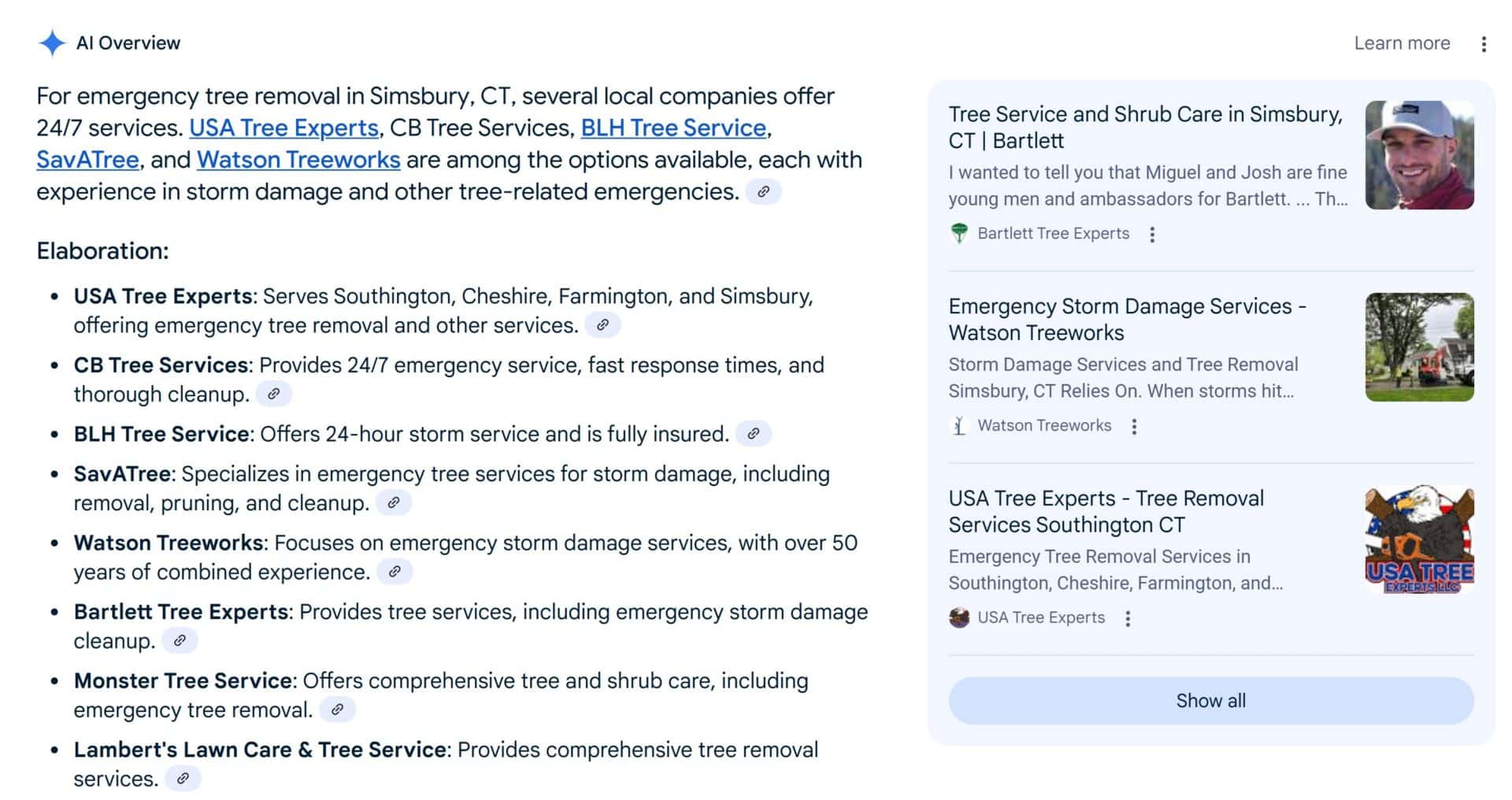
That single placement sends them more qualified calls in a week than three months of HomeAdvisor leads ever did. And here’s the part that matters: it’s compounding. The traffic, the calls, the reviews, the local authority — every month it gets stronger, not weaker. Pay-per-lead works backwards. The day you stop paying, the leads stop. SEO works forwards. The day you stop paying, the rankings keep working for months while you keep building.
The Local SEO System for CT Contractors
Here’s the actual system. Not theory — what I run for clients. There are five pieces, in order of importance.
1Google Business Profile (GBP) Highest Impact
This is the single highest-leverage asset you own online, and most contractors treat it like a business card they printed once and forgot about. Your GBP is what powers the Map Pack. If it’s weak, you don’t rank — full stop.
What “optimized” actually means:
- Primary category set correctly (the most-searched-for category that matches your business)
- Every secondary category that applies — not just one
- Service area covering every CT town you actually work in
- Hours accurate, including holidays
- Services list filled out with descriptions for every service you offer
- 20+ photos, geo-tagged, showing real jobs and real trucks (not stock photos)
- Weekly Google Posts — yes, weekly
- Q&A section seeded with questions you actually get asked
- Active review generation — minimum 5 new reviews per month
I have a full breakdown of GBP optimization coming in the next post on this blog, but if your profile is missing more than two of those, that’s where to start. Today.
2Reviews — But the Right Way Ongoing
Reviews are the second-biggest local ranking factor after the GBP itself. But not just any reviews. Google looks at three things:
- Volume — total number of reviews
- Velocity — how often new ones come in
- Keywords — what customers actually say
That last one is huge and almost nobody knows it. Google’s own guidance on local business confirms that review content is a relevance signal. If a customer writes “John fixed our AC in Plainville same day, great service” — Google now associates your business with “AC” and “Plainville.” If every review just says “great service, thanks!” you’re getting credit for nothing specific.
The fix: a review request system that goes out automatically after every job, with a soft prompt like “If it’s not too much trouble, mention what we did and the town we were in.” Most CRMs and field-service apps can do this. If yours can’t, you need a different one.
3A Real Website (Not a Brochure) Foundation
Here’s where most CT contractors lose. They have a website that’s basically a four-page online brochure: Home, About, Services, Contact. Loads slow on mobile. No location pages. No service-specific content. Google has no idea where you work or what you do.
What you actually need:
- A dedicated page for every service you offer (drain cleaning, water heater install, sewer line repair, etc.)
- A dedicated page for every town you serve — Plumber in Bristol, Plumber in Southington, Plumber in Cheshire, etc.
- Pages that combine the two for your top markets — “Drain Cleaning in Southington CT”
- Schema markup (LocalBusiness, Service) so Google can read the page as a structured local result
- Real photos of your team, your trucks, your work — not stock images
- Sub-2-second load times on mobile (this matters more than people think)
This is exactly what we build for clients on the SEO services side — the website is the foundation. Without it, GBP can carry you partway, but you’ll plateau.

4Local Citations and NAP Consistency Trust Signal
NAP = Name, Address, Phone. If your business is listed differently in 47 different directories — different phone numbers, abbreviated street names, old suite numbers — Google starts second-guessing whether you’re a real, trustworthy business. Inconsistent NAP is a silent killer.
You need your business listed correctly on the major data aggregators (Yelp, Bing Places, Apple Maps, Yellow Pages, BBB, Angi yes even Angi, the chamber of commerce, your trade-association directories). Not 500 spammy directories — that’s the old playbook. The current playbook is the 30-50 that actually matter for CT and your industry, with identical NAP across all of them.
5Backlinks From Real Connecticut Sources Authority
Backlinks are still a top-three ranking factor, but the rules changed. Google doesn’t care how many you have — it cares whether they’re from real, relevant, local sources.
For a CT contractor, the gold-tier links are:
- Local newspapers (Hartford Courant, local Patch sites, town newspapers)
- Connecticut chambers of commerce
- Trade associations (CT HVAC Contractors Association, etc.)
- Local business partner cross-links (your supplier, the realtors you work with, the property managers you service)
- Sponsorships of local Little League teams, school fundraisers, charity events
One link from the Cheshire Patch is worth a hundred from some sketchy directory in India. This is what tipped USA Tree into AI Overview territory — they’re tied into the local CT ecosystem in a way Google can verify.
The compound effect: GBP gets you in the Map Pack. Reviews push you up the Map Pack. The website lets you rank for more terms in more towns. Citations confirm you’re real. Backlinks tell Google you’re an authority. None of these work great alone. Stacked together, they’re how a small contractor beats huge competitors who outspend them 10:1.
What This Looks Like in Months 1, 3, and 6
One question I get every single intro call: “How fast does this work?” Honest answer:
Month 1: The foundation goes in. GBP rebuilt, citations fixed, website pages restructured. You probably won’t see a big traffic bump yet. What you will see is your GBP starting to show up for branded searches and a few long-tail terms.
Month 3: Map Pack movement starts. You’ll see your business cracking the top 10, then the top 5, for your main service-plus-town terms. Calls increase but it’s not a flood yet. Reviews are coming in steadily.
Month 6: This is when it kicks in. Multiple Map Pack rankings, organic traffic starting to climb, the phone ringing for jobs you didn’t pay a single dollar to acquire. This is the point USA Tree hit, and it’s also the point where most contractors stop buying shared leads entirely.
Month 12: Compounding. You’ve got a stack of reviews, dozens of ranked pages, real backlinks, a moat your competition can’t easily catch up on. Your cost per lead is approaching zero. You’re picking which jobs to take instead of begging for them.

What You Can Do This Week
If you’re reading this and thinking “okay, but what do I actually do tomorrow morning?” — here’s the short list. None of this requires hiring anyone. None of it costs money:
- Log in to your Google Business Profile. Check your primary category — is it the most accurate one for your business? Add every applicable secondary category.
- Add 10 new photos this week. Real photos. Trucks, jobs, team. Geo-tag them where possible.
- Text the last five customers you served. Send them your Google review link. Ask them to mention what you did and the town they’re in.
- Google your business name. Then Google “[your service] [your town].” See where you rank. If you’re not in the top 3, you have work to do.
- Write down the 10 CT towns you most want to work in. Those are your target markets. Your website needs a page for each.
That’s a real week of work, and it’ll move the needle. If you do nothing else, do those five things.
Why Most Contractors Won’t Do This
Honest moment. Most CT contractors who read this post will close the tab and keep paying Angi. Not because the system doesn’t work — it absolutely does. Because they’re already drowning. They’re in the truck 12 hours a day, they don’t have a marketing person, and the idea of optimizing 47 things on their Google profile feels like a fifth job.
I get it. That’s why agencies exist. The contractors who win are the ones who either build it themselves over six months of nights and weekends, or hand it to someone who’s already done it 50 times. Either way works. Doing nothing doesn’t.
If you want the deeper version of this — the actual playbook with checklists and scripts — I put together a free PDF called Stop Buying Leads 2025. No email opt-in, just download it. It expands on every step in this post.
Get Off the Lead-Buying Treadmill
I work with a small number of CT home-service contractors at any given time. Free 30-minute strategy call — I’ll audit your current local SEO setup live, tell you the three things to fix first, and you’ll walk away with a plan whether you hire us or not.