
Why Connecticut Contractors Are Losing Jobs to Competitors With Better Websites
This week alone, you lost roughly $4,800 worth of work to the contractor down the road who has a better website than yours. You don’t know it happened, because the homeowner never called you. They opened your site, took 1.7 seconds to decide it looked stale, hit the back button, and called the next guy. That’s three jobs gone. Maybe four. And it’s going to happen again next week.
I’m Glenn. I run Southington Digital Solutions, and I’m not going to soft-pedal this. The CT contractors I see losing the most jobs aren’t losing them on price. They’re not losing them on skill. They’re losing them on the seven seconds between a homeowner clicking their website and deciding whether to call. If those seven seconds don’t sell, nothing else matters. The truck, the license, the 20 years of experience — all invisible.
This post is about the actual dollars walking out the door. Not theory. Real money, real scenarios, real numbers from the CT home-services market.
The Math: What a Bad Website Actually Costs You
Let’s run the numbers. I’ll use HVAC because the math works similarly across trades — adjust for your average ticket.
A typical CT HVAC company gets somewhere between 200-600 unique visitors to their website per month from Google search alone (assuming basic local SEO presence). On a strong website, somewhere between 5-8% of those visitors will call or fill out a form. On a weak website, that number is closer to 1-2%. The site itself is the variable.
Let’s split the difference. Say 400 visitors a month. Strong site: 6% conversion = 24 leads. Weak site: 1.5% conversion = 6 leads. That’s a 18-lead-per-month difference, just from the site. If you close 40% of leads at an average ticket of $1,400, that gap is:
Per month, lost to a weak website (avg HVAC scenario)
Per month. Every month. Roughly $120,000 a year, walking past your door because your website didn’t close visitors who were already on it. And I’m being conservative here. For roofers and remodelers with $8,000-$25,000 average tickets, the numbers are wildly worse.
Reality check: The traffic was already there. Google sent it to you. The homeowner had a problem you solve, in a town you serve, with cash to spend. Your website is the only reason they didn’t become a customer. That’s not a marketing problem — that’s a closing problem. And it’s happening this week, this month, every month.
The Seven Seconds That Decide Everything
Studies on user behavior on small business websites are remarkably consistent: visitors decide whether to stay or leave in roughly 5-8 seconds. Not from reading anything — from a gut-feel scan of “does this look like a real, trustworthy company I should call?”
What kills you in those seven seconds:
- Slow loading. If your site takes more than 3 seconds to render on mobile, half your traffic is already gone. CT homeowners on a phone in their driveway have zero patience.
- Stale design. A site that looks like 2014 reads as “this business might not even still exist” to a 2026 homeowner.
- Stock photos. Three guys in matching khakis from a stock library smiling at a furnace. Customers can smell stock photos from a mile away. Instant trust killer.
- No phone number visible. If the customer has to scroll or hunt for a way to call you, they’re already gone.
- Generic text. “We provide quality HVAC services to our customers.” Could be any company anywhere. Says nothing.
- Broken stuff. Forms that don’t work. Pages that 404. Links to a “Specials” page from 2019. Each one is a “they don’t pay attention to detail” signal.
The competitor down the road who has a clean, fast site with real photos of his trucks in your town and a giant phone number at the top? He just got the call you didn’t.
“The truck, the license, the 20 years of experience — all invisible. Your website is the only thing standing between a homeowner’s search and your phone ringing.”
Real Scenarios: Where Jobs Are Actually Lost
Let me walk through three scenarios I’ve personally watched play out in CT this year.
Scenario 1: The 11 PM Burst Pipe
Cheshire homeowner. Pipe bursts at 11:14 PM. She Googles “emergency plumber Cheshire CT” on her phone, water still running across the kitchen floor. Three plumbers in the Map Pack. She taps the first one. The site loads in 8 seconds (the photos are huge, uncompressed). Halfway through loading, she taps back and tries the second one.
Second site loads instantly. Phone number is huge at the top. There’s a line that says “24/7 emergency response — usually 45 minutes or less in Cheshire.” She taps the phone number. Calls. Job booked. $1,800 ticket plus the recurring relationship for the next 10 years.
Plumber #1 didn’t lose because he was bad at his job. He lost because his site loaded slowly and didn’t sell trust in five seconds. He’ll never know that call existed.
Scenario 2: The Roof Quote Comparison
Berlin homeowner needs a new roof. Asphalt shingle, mid-range. He’s getting three quotes. He’s already decided to use whoever feels most professional. He visits all three roofers’ websites before scheduling estimates.
- Roofer A: Site is from 2017. Bad photos. “Family owned and operated” tagline. No project gallery. No reviews on the page. He doesn’t even bother calling.
- Roofer B: Decent site. Some photos. A Google reviews badge showing 4.8 stars. He calls and books an estimate.
- Roofer C: Sharp site. Real before/after photos from a Berlin job last month. Specific shingle brands listed. Process page that explains the whole project step-by-step. Financing partner shown. He calls and books an estimate.
By the time the estimates come in, the homeowner has already made up his mind: it’s between B and C. Roofer C’s quote is $1,200 higher than Roofer B. He picks Roofer C anyway. The job is $19,400. Roofer A is invisible — he never even got the chance to compete. His website disqualified him before the conversation started.
Scenario 3: The Contractor Who Found Out He’d Been Losing Jobs for Years
This one’s real, lightly anonymized. CT electrician, been in business 18 years. Solid reputation, great work, well-liked locally. Came to me because he felt like business “wasn’t growing the way it should.” We looked at his analytics together.
His site was getting 320 visitors per month from Google. His phone was ringing roughly 8 times per month from web traffic. That’s a 2.5% conversion. For a service business with that kind of search volume, conversion should be 6-10%. We rebuilt the site — cleaner design, real photos, town-specific service pages, a reviews integration showing the 87 5-star Google reviews he’d been hiding from his own website. Three months later, same traffic levels, his phone was ringing 22 times per month from the web. From the same traffic. Just a better closer.
That delta — 14 extra calls a month at his close rate and average ticket — was around $9,000/month. He’d been leaving that on the table for years. Years.

What a “Better Website” Actually Looks Like in 2026
Let me be specific about what wins. This isn’t about being flashy or having animations. The contractors winning the CT market right now have websites that do these things, full stop:
1Loads Fast on Mobile Critical
Sub-2-second load on a 4G connection. 80%+ of your traffic is mobile — Statista confirms mobile accounts for over 58% of global web traffic, and for local service searches it skews even higher. If your site is slow on a phone, you’re done. Run your site through Google PageSpeed Insights. If your mobile score is below 70, you have a problem. Below 50, it’s a 911. The fix is usually image compression, removing bloated plugins, and switching to a faster theme/host.
2Phone Number Above the Fold 2 Minutes to Fix, Click-to-Call
The phone number is in the top right of the desktop site, and at the very top of the mobile site, in big readable text, with a click-to-call link. The number appears on every page. This is non-negotiable. Half the homeowners visiting your site want to call now, not read.
3Real Photos, Not Stock Trust Builder
Your trucks. Your team. Your jobs. Before-and-after shots. The actual work. A project gallery. Stock photography is poison in 2026. Customers can smell it instantly, and it kills the trust equation.
4Town-Specific Service Pages SEO + Conversion
You don’t have one services page. You have:
- One page per service (“Drain Cleaning,” “Sewer Line Repair,” “Water Heater Installation”)
- One page per town you serve (“Plumber in Bristol CT,” “Plumber in Southington CT”)
- Combo pages for your top markets (“Drain Cleaning in Bristol CT”)
This isn’t just for SEO — though it helps massively. It’s because a Plainville homeowner who lands on a page titled “Plumber in Plainville CT” with photos from a Plainville job and a testimonial from a Plainville customer feels seen in a way generic content never delivers.
5Reviews Showing on Every Page Instant Trust
87 five-star Google reviews and zero of them showing on your website is a colossal mistake. Embed a real-time Google reviews widget so the social proof is visible. Highlight the best ones. Make them impossible to miss.
6Trust Markers Stacked Conversion Lift
License numbers. Insurance verification. BBB rating. Years in business. Member of CT trade associations. Google review badge. Awards. Whatever proof you have, surface it. CT homeowners are particularly skeptical of contractors after years of bad-actor stories — show your credentials.
7A Real CTA on Every Page Revenue Direct
Every page on the site, not just the homepage, has a clear next step. Call now, request a quote, schedule service. Make it stupid-obvious what to do. Sticky call buttons on mobile are huge — they keep the action visible no matter how far the user scrolls.
The USA Tree Experts Story (Again, Because It’s Worth Repeating)
Same story I keep telling, because it’s the cleanest example I have. USA Tree Experts came to me with a website that was, frankly, embarrassing. Slow, ugly, no service pages, generic copy, broken contact form. Their actual work was excellent, but you’d never know it from the site.
We rebuilt the entire site alongside their local SEO program. Real photos of actual tree removal jobs across CT. Town pages for Simsbury, Avon, Granby, Canton, West Hartford, Farmington. Service-specific pages for emergency tree removal, tree trimming, stump grinding, storm cleanup. Fast load times, mobile-first design, sticky call button, Google reviews integration.
Combine that with the Google Business Profile work, and the result is what’s now in the AI Overview for “emergency tree removal in Simsbury CT”:
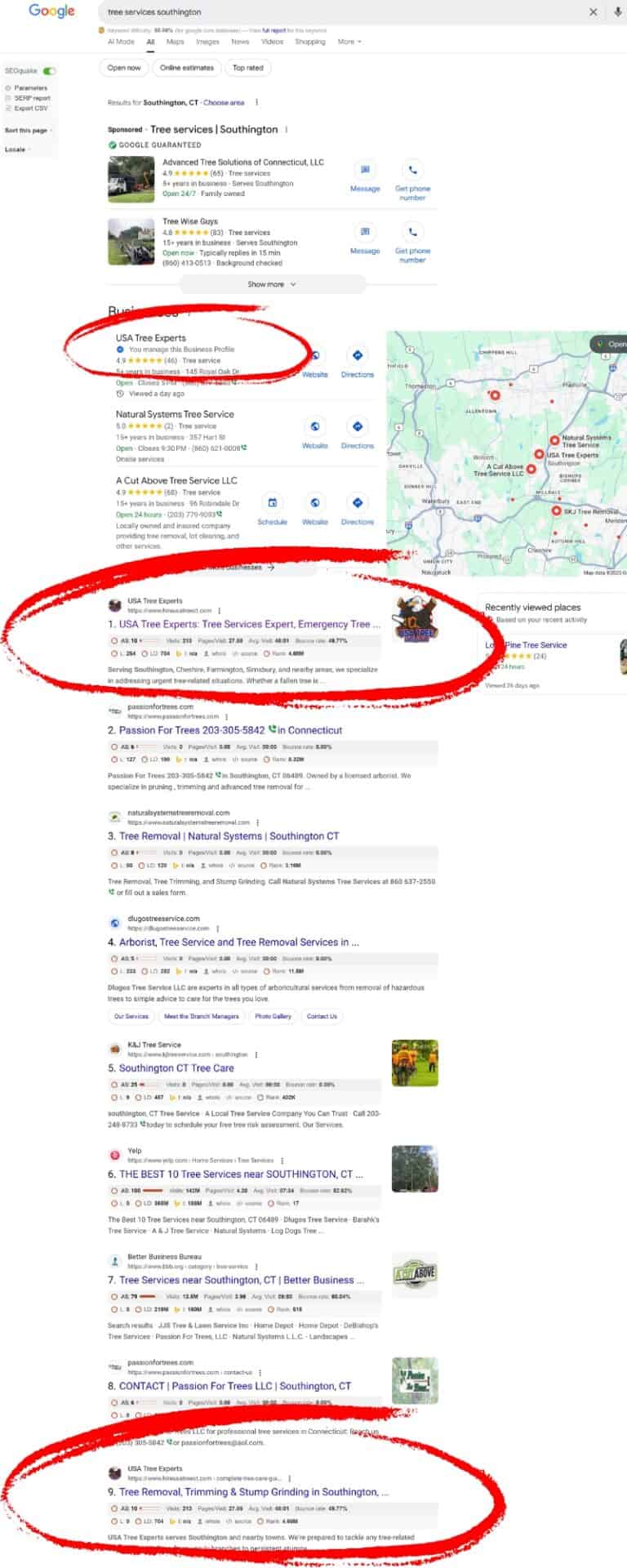
The website wasn’t an aesthetic decision. It was a revenue decision. Same traffic on a weak site converts at 1.5%. On a strong site, 6-8%. That delta is the entire business case.
Here’s the thing nobody tells you: a great website doesn’t have to be expensive. It has to be specific to your trade and your towns. Most contractors get talked into $15,000 sites with animations and bells and whistles. What you actually need is fast, clear, trust-heavy, locally focused, and built to convert. That can be done well at a fraction of the price if you work with someone who knows the home-services market.
The Audit You Can Do in 10 Minutes
Pull up your own site. Be honest. Check these:
- Open it on your phone. Time how long it takes to fully load. If it’s over 3 seconds, you’re losing visitors before they even see the homepage.
- Is your phone number at the top of the screen, big, in a color that stands out? Or is it tucked in the footer somewhere?
- Look at the photos. Real photos of your team and trucks, or generic stock images of smiling people?
- How many pages does your site have? If under 10, you’re missing service pages, town pages, or both.
- Find a customer review on the homepage. Can you? If not, you’re hiding your best asset.
- Look at your “About” page. Is it specific to you and your story, or does it read like every contractor’s About page?
- Click through 5 random pages. Anything broken? Forms work? Links work?
- Check your Google PageSpeed score (search “pagespeed insights” and paste your URL). Under 70 on mobile is a problem.
If more than two of those came back ugly, you have a website that’s actively losing you jobs every week. Not could be. Is.
Stop Bleeding Jobs to the Other Guy
The contractors winning the CT home-services market right now aren’t smarter than you, harder-working than you, or better at the trade. They have an online front door that closes the visitors Google sends them. You can have that too. The math will pay for itself inside a few months — usually fast.
The question is whether you want to keep losing $5,000-$15,000 a month to the next guy, or fix it.
See What Your Site Is Costing You
Free 30-minute call. I’ll screen-share your website, walk through every conversion problem I see, and put a real dollar figure on what it’s costing you each month. No pitch unless you ask. You’ll leave with a punch list whether we work together or not.